Thursday, May 6, 2010

Model


Project 2 Submission

Narrative

The solitary man sits in a concrete block gazing at the conservative order through the window. He is no friend of the outdated world, in fact he does not deign to bother as long as his castle stands.


Design Concept

What I want to achieve here is to design a series of spaces for the solitary man who rather stays in his contemporary "Castle" than get involved in what he calls the "outdated world". The site is placed in the traditional residential area of Tokyo, Japan, due to the land limitation the buildings within this area are built right next to each other, which indicates his "Castle" is surrounded by so called "conservative order".

In the painting, the guy appears sitting alone in a rectangular prism made of concrete with large openings on the wall. This is to me, the representation of modernism in contrast to the surrounding obsolete order. Therefore rectangular shapes are intensively adopted in the design symbolizing the contemporary order.

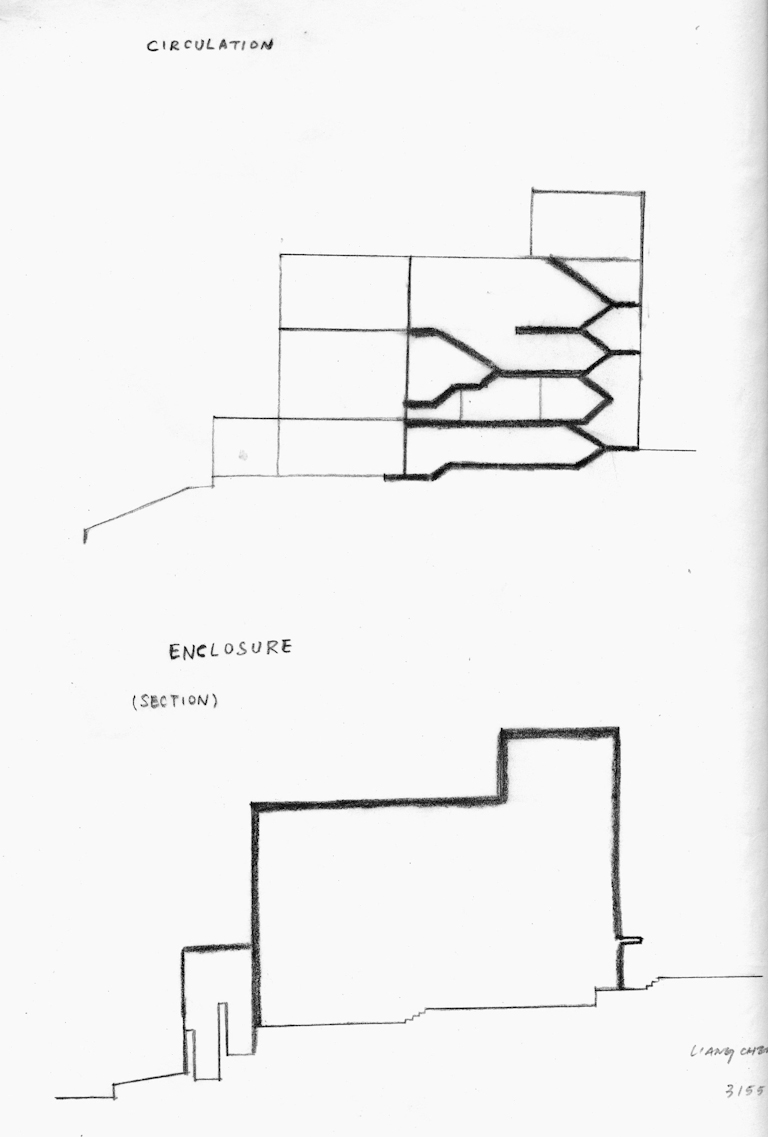
The cube in the drawing below represents the surrounding conservative order where activities are contained as a whole under one single roof. To differentiate from this conservative order, the rooms are separated and sorted according to their functionality. An inner courtyard is bounded in the middle as nature no doubt plays a significant role in every day's life, even for the lonely man. However he only wants to stay in his little world, so bringing the nature into his castle is essential. Based on this idea, the courtyards have been positioned very carefully: large openings are created at both sides facing towards the middle courtyard, so the lonely man can enjoy nature without going out to the conservative world. Another reason for this arrangement is letting the light into the interior spaces, there are also some small openings on the roof designed to serve this purpose. the front courtyard is a more private outdoor space connecting to the living room which also ensure that there is sufficient light in this room.

The contact between the "Castle" and the outside obsolete world is limited, as stated in the narrative, the solitary man does not want to be bothered, his privacy has to be well protected. This is done by only employing opening (entrance) at the front facade following a long narrow corridor to the left and three small windows at the rear facade where the hypocritical man can sit on the roof and observe the outside world if he has to. Basically everything he needs for everyday life is included in his "castle", light, trees, beautiful view of the courtyard...therefore he can comfortably live his life in the way he wants.


Ground Floor Plan 1:100


First Floor Plan 1:100


Section View 1:100


Axonometric 1:200

Tuesday, April 27, 2010

The site

My site will be located in a typical residential district of Tokyo, Japan. An ultra modern city and yet contains a trace of heritage order, a high intensity residential area but in an ordered manner...


Wednesday, April 21, 2010

The famous Nighthawks

Too bad that I didn't go with this one...xD


Office in a small city, 1953


Office in a small city


Edward Hopper and his wife first rented a cottage in Truro, Massachusetts, in the summer of 1930, and they would return there regularly through the 1950s. Hopper began Office in a Small City while he was staying in Truro in the summer of 1953, and he finished it in his New York studio in the fall. Rather than depicting the Cape Cod landscape, however, Office in a Small City is a scene that could have taken place in any American town in the mid-twentieth century. Hopper's explanation of his earlier work Office at Night (1940; Walker Art Center, Minneapolis) also applies to this painting: "My aim was to try to give the sense of an isolated and lonely office interior rather high in the air, with the office furniture which has a very definite meaning to me."

The solitary office worker in this scene is isolated both physically and emotionally. There is no indication of his particular profession, as he sits in his shirtsleeves; he appears, in fact, to be daydreaming rather than working. The postwar culture of American business is evident in the mass-produced office furniture, the impersonal atmosphere of the office itself, and the man's detachment from his unseen coworkers. Despite the light and air afforded by his corner office, he appears trapped in place. He is framed by the office window, and his head is profiled against another window and the wall of the building beyond, in a manner that suggests his containment within his environment. The solitude of the man, and the contrast between the stark, utilitarian upper story of the building and its decorative false front, visible at the lower right, suggest Hopper's own ambivalence toward modern urban life.

Reference
http://www.metny.net/toah/works-of-art/53.183


Key words set 1

Isolated
Daydream
Framed
Trapped
Containment
Utilitarian
Solitude
Contrast

Key words set 2

Physically
Emotionally
Light
Air
Office window
Window
Wall


Key word set 3

ambivalence


Working Narrative

The solitary architect sits in a raw concrete block planning his dream city in the head...

The solitary architect trapped in a set of frames, confronts the conservative order finding his way to the future...

The architect confronts the conservative order alone through a set of raw frames where he will find his way to the future...

An revolutionist confronts the conservative order alone through a set of concrete scenes where he will find his way to the future...

The solitary man sits in a concrete block gazing at the conservative order through the window. He is not afraid of confronting the obsolete system, in fact, he will bring change to the community...

The solitary man sits in a concrete block gazing at the conservative order through the window. He can not help himself wondering "What I have to do to make this world more conservative?"


Final Narrative

The solitary man sits in a concrete block gazing at the conservative order through the window. He is no friend of the outdated world, in fact he does not deign to bother as long as his castle stands.


Project 2: Room and Narrative


About Edward Hopper


Edward Hopper, the best-known American realist of the inter-war period, once said: 'The man's the work. Something doesn't come out of nothing.' This offers a clue to interpreting the work of an artist who was not only intensely private, but who made solitude and introspection important themes in his painting.


He painted hotels, motels, trains and highways, and also liked to paint the public and semi-public places where people gathered: restaurants, theatres, cinemas and offices. But even in these paintings he stressed the theme of loneliness - his theatres are often semideserted, with a few patrons waiting for the curtain to go up or the performers isolated in the fierce light of the stage. Hopper was a frequent movie-goer, and there is often a cinematic quality in his work. As the years went on, however, he found suitable subjects increasingly difficult to discover, and often felt blocked and unable to paint. His contemporary the painter Charles Burchfield wrote: 'With Hopper the whole fabric of his art seems to be interwoven with his personal character and manner of living.' When the link between the outer world he observed and the inner world of feeling and fantasy broke, Hopper found he was unable to create.


From the time of his marriage, Hopper's professional fortunes changed. His second solo show, at the Rehn Gallery in New York in 1924, was a sell-out. The following year, he painted what is now generally acknowledged to be his first fully mature picture, The House by the Railroad. With its deliberate, disciplined spareness, this is typical of what he was to create thereafter. His paintings combine apparently incompatible qualities. Modern in their bleakness and simplicity, they are also full of nostalgia for the puritan virtues of the American past - the kind of quirky nineteenth-century architecture Hopper liked to paint, for instance, could not have been more out of fashion than it was in the mid-192OS, when he first began to look at it seriously. Though his compositions are supposedly realist they also make frequent use of covert symbolism. Hopper's paintings have, in this respect, been rather aptly compared to the realist plays of Ibsen, a writer whom he admired.


Paintings such as Nighthawks (Art Institute of Chicago, 1942) convey a mood of loneliness and desolation by their emptiness or by the presence of anonymous, non-communicating figures. But of this picture Hopper said: `I didn't see it as particularly lonely... Unconsciously, probably, I was painting the loneliness of a large city.' Deliberately so or not, in his still, reserved, and blandly handled paintings Hopper often exerts a powerful psychological impact -- distantly akin to that made by the Metaphysical painter de Chirico; but while de Chirico's effect was obtained by making the unreal seem real, Hopper's was rooted in the presentation of the familiar and concrete.


Hopper’s spatial constructions irritate the viewer and their natural understanding of space; they renounce Alberti’s famous view through a window through surreal light conditions and shadows, as well as unreal perspectives, and unfold a realism that is fragile and again and again reveals tendencies towards abstraction and a geometrization of the pictorial surface. Hopper’s psychologically charged interior and exterior spaces seem to merge, and we repeatedly come upon threshold motifs such as windows, balconies, and doors. Spatial boundaries blur and are accentuated at the same time. In their prototypical representation, Hopper’s figures make us think of the manichini of the Pittura metafisica, they have almost no individual features and strike us as isolated, cut off from others, melancholy, and introverted.


Edward Hopper once remarked, “To me, the important thing is the sense of going on. You know how beautiful things are when you’re travelling.” Travelling provided Hopper with the subjects for his pictures, which were also a source of inspiration. Movement and standstill are two cornerstones of his art. He loved the cinema, and the cinema loved him. The filmic as such is crucial for his works because the static character of his paintings conveys itself as an indefinitely expanded instantaneous exposure that can only be explained through movement. The transformation of time into space is as key as the transformation of space into time. With this approach, Edward Hopper inspired not only a wide range of film makers like Alfred Hitchcock, Ridley Scott, and Wim Wenders, but also sculptors, photographers, video artists, and writers such as Peter Handke and Paul Auster.

Reference

"Lives of the Great 20th-Century Artists", by Edward Lucie-Smith


Tuesday, April 6, 2010